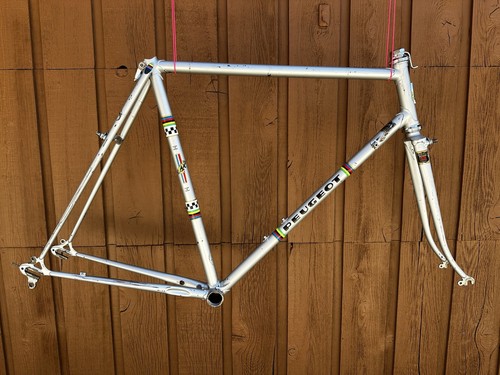
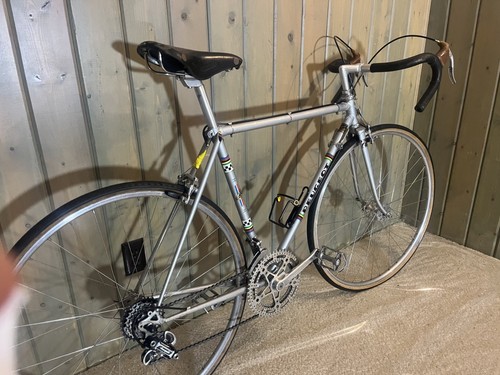
- Tubing
- The 1977 and 1978 US catalogs list Reynolds 531 butted tubing for the PY-10. The 1980 PY10CP was offered in 531 or 753 extra-légère, so read the decal before you believe a 753 claim. A bike shop that sold them recalled an all-531 double-butted frame and fork.
- The frame
- It's a Nervex-lugged frame with forged Simplex dropouts and chromed fork crown, fork ends and rear stays. Ask for close photos of the chrome. Pitting there is common on old Peugeots, and rust under the chrome is hard to fix.
- Sizing
- Peugeot sold the PY-10 as a special-order, hand-made professional bike in 52 to 64 cm, and the 1978 catalog offered a personalized frame. That means two PY-10s can differ, so get the seat tube and top tube measured.
- Threads and standards
- Expect French threading, 35 x 1 mm, on a 1970s Peugeot like this one, plus a French headset and a 22.0 mm stem. French bottom bracket cups are scarce. Phil Wood French rings or a Velo Orange threadless cartridge are the usual fixes.
- Wheels
- The 1977 PY10E came on Super Champion tubulars, and later ones offered tubulars or clincher rims. The 1978 and 1980 catalogs list a 6-speed Maillard freewheel. Measure the rear spacing before you buy wheels.
- Parts it came with
- The 1977 PY10E had an anodized gold Simplex Super LJ group, Stronglight 105 cranks, anodized Mafac Competition brakes, an Atax Peugeot stem and an Ideale 2002 saddle on a Simplex post. The 1980 PY10CP moved to Stronglight 106 cranks and Mafac LS2 sidepulls or GT centerpulls. No catalog we found lists Campagnolo.
- Dating it
- The steel PY-10 appears in the 1977, 1978 and 1980 US catalogs as the PY10E and then PY10CP Prestige. From 1983 the PY10FC name went on a carbon-tubed frame, a different bike. Component date stamps help pin the year.
- Paint and decals
- Catalog colors were white, blue, red, silver, black and bronze in 1977, and pearl colors in 1978. Ask about the paint history, since a special-order frame could be ordered in more than one color.
- Safety jobs
- Replace old tubulars and hardened brake pads before riding. Check the stem and bars for cracks, and remember French stems need a French or sanded-down replacement.
Check the listing photos against these lists, and ask the seller about anything you can’t see. Swapped or missing original parts should come off the price if originality matters to you. For replacements, see our vintage components guide.